Views: 0 Author: Site Editor Publish Time: 2026-09-17 Origin: Site


How does a machine know how many turns it has made, or exactly where it is? The answer lies in a small but critical component: the encoder.
Without an encoder, a motor can still spin, but the control system has no idea where it has turned. A robotic arm can move, but its joint angle cannot be verified. An elevator can go up and down, but it cannot stop precisely at a floor. An encoder converts mechanical motion into electrical signals, allowing the control system to “see” position, speed, and direction.
Two Basic Types: Incremental and Absolute
Encoders fall into two main categories: incremental and absolute.
An incremental encoder outputs pulse signals. Each time the shaft rotates by a fixed angle, it sends a pulse. The control system counts these pulses to calculate distance traveled. The advantages are simple structure, fast response, and relatively low cost. The downside: once power is lost, position information disappears. On restart, the system must return to a reference point — a process known as “homing” — before it can work again.
An absolute encoder is different. It assigns a unique digital code to every shaft position, like a house number. Whether power is on or off, the control system can read the exact position directly. Multi-turn absolute encoders can also record how many full rotations the shaft has made. This means after a power failure, the machine does not need to home — it can resume work immediately. For robots, elevators, medical equipment, and other safety-critical applications, this is essential.
Key Parameters: Resolution, Accuracy, Protection Rating
When selecting an encoder, several parameters deserve special attention.
Resolution is usually expressed in pulses per revolution (PPR) or bits. Higher resolution means finer measurement. But resolution is not the same as accuracy. Accuracy refers to the deviation between the measured value and the true value, affected by code disc manufacturing quality, optoelectronic system stability, installation concentricity, and other factors.
Protection rating is indicated by an IP code. IP65 means completely dust-tight and protected against water spray. IP67 allows short-term immersion. In dusty, humid, or outdoor environments, the protection rating directly determines whether the encoder can operate reliably over the long term.
Interface protocol also matters. Common incremental outputs include TTL, HTL, and push-pull. Absolute encoders often use digital protocols such as SSI, BiSS-C, and RS485. Choosing an interface compatible with the controller ensures smooth integration.
Why Encoders Are So Critical
Modern industrial equipment generally uses closed-loop control. The controller sends a command, the motor executes the motion, the encoder provides real-time feedback on actual position and speed, and the controller adjusts based on the deviation. In this loop, the encoder is the “sensing” element. Without accurate feedback, even the best control algorithm cannot achieve precise motion.
In high-end equipment, encoder performance often determines the accuracy limit of the entire machine. The machining accuracy of CNC tools, the repeat positioning accuracy of robots, and the leveling accuracy of elevators are all directly related to the encoder.
From Light to Electricity: One Technical Path
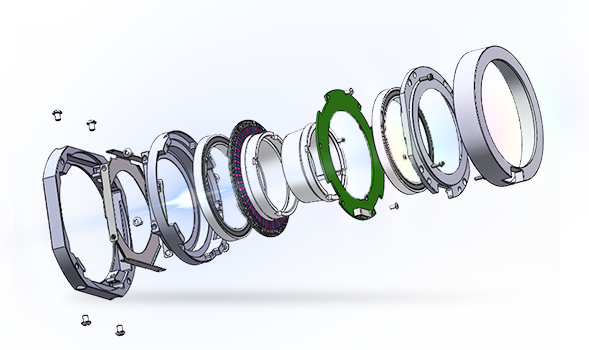
Among various encoder types, optical encoders are widely used for their high precision and stability. At their core is a code disc with precision grating lines. Light passes through the transparent and opaque areas of the disc and is received by photoelectric sensors, converted into electrical signals. The manufacturing precision of the code disc directly determines the encoder’s resolution and signal quality.
Shanghai Hengxiang Optical Electronics Co., Ltd. has focused on high-precision optical encoders since 2001. Its predecessor dates back to an optical instrument factory established in 1985, with deep experience in optical cold working. This optical heritage gives Hengxiang complete control over the code disc — the core component — from materials to processes.
Conclusion
An encoder may not be the most visible part of a machine, but it is the starting point of precise motion. From CNC machine tools to industrial robots, from elevators to medical equipment, any machine that needs to “know where it is” relies on it. Understanding encoders is the first step to understanding how modern industry achieves precise control.