Views: 64457 Author: Site Editor Publish Time: 2026-11-09 Origin: Site


Selecting the right encoder is critical for the performance and reliability of your automation systems. However, engineers often get confused by industry terminology. To make the right choice, it is essential to understand that encoders are categorized by
two independent dimensions: Physical Principle (Optical vs. Magnetic) and Output Logic (Absolute vs. Incremental).
Here is a comprehensive guide to help you find the perfect fit for your next project.
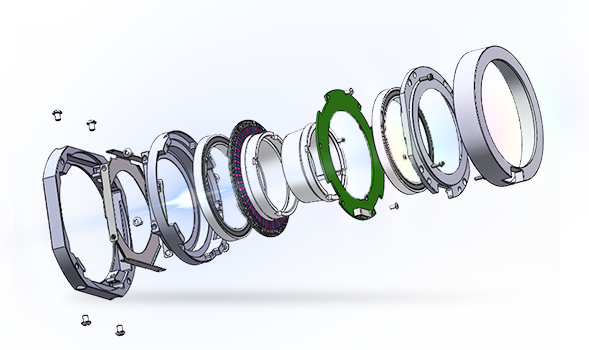
Optical encoders are currently the most mature and precise category in industrial applications. Their core principle relies on light passing through a rotating precision grating disc, which is then received by photoelectric elements and converted into electrical signals.
Pros:
Ultra-High Precision & Resolution: The lines on a grating disc can be microscopically fine, allowing for extremely high resolution and arc-second precision. They are the top choice for precision machining and high-end measurement.
High-Speed Response: Non-contact optical transmission ensures near-zero delay, making them ideal for high-speed motors.
Strong Immunity to Electromagnetic Interference (EMI): Optical signals are unaffected by general industrial electromagnetic fields.
Cons:
Sensitive to Harsh Environments: This is the Achilles' heel of optical encoders. If dust, oil, or moisture invade the internal components, the light path is obstructed, and the signal will instantly drop or error out.
Vibration Sensitivity: The internal structure is delicate. Strong vibrations or shocks can easily cause the code disc to shatter or the optical path to misalign.
Magnetic encoders replace the optical grating disc with a magnetic rotor/drum, measuring angles by sensing changes in the magnetic field using magnetoresistive or Hall effect elements.
Pros:
Exceptional Environmental Resistance: They are immune to dust, oil, and moisture, and can easily achieve IP67 or higher protection ratings. They perform exceptionally well in construction machinery, outdoor equipment, and harsh working conditions.
Vibration & Shock Resistant: Many magnetic encoders utilize a bearingless and off-axis design. With a simple physical structure, they output stably even under severe vibration.
Maintenance-Free & Long Lifespan: Non-contact magnetic sensing involves almost zero mechanical wear, enabling truly maintenance-free operation.
Cons:
Precision Ceiling: Compared to top-tier optical encoders, magnetic encoders generally lag in resolution, accuracy, and linearity.
Susceptible to External Magnetic Interference: If strong magnetic equipment (like large electromagnets or heavy-duty motors) is nearby, the measurement can be interfered with.
Temperature Drift: Magnetic materials are sensitive to temperature changes, which may cause slight accuracy drift in extreme temperatures.
Part 2: Output Logic (Absolute vs. Incremental)
It is important to clarify that "absolute" describes the output logic (as opposed to "incremental"). The defining feature of an absolute encoder is that every position corresponds to a unique digital code.
Pros:
Power-Off Memory (Absolute Position): This is its core advantage. No matter how long the equipment is powered off or stopped, the encoder immediately tells the system its exact position upon power-up—no "homing" operation is required.
High Safety: For equipment like elevators, robotic arms, and wind turbines where position loss is unacceptable, absolute encoders prevent crash risks caused by failed homing.
Strong Anti-Interference: Using digital protocols (like SSI, BiSS, etc.) for transmission, signals are less likely to drop packets over long distances.
Cons:
Higher Cost: The internal structure is more complex. Multi-turn absolute encoders require battery backup or special mechanical gear structures, making them generally more expensive.
Strict Installation Requirements: To ensure continuous reading of absolute positions, the concentricity and alignment between the code disc and the shaft must be extremely precise.
(Note: In contrast, Incremental Encoders are more cost-effective but require a homing routine upon every power-up, which increases downtime and operational risk.)
In practical engineering selection, these concepts are not mutually exclusive; they are complementary.
Seeking ultimate precision in a well-controlled environment? An optical encoder is the top choice.
Facing wind, rain, oil, and dust while demanding maintenance-free operation? A magnetic encoder is the rugged answer.
Having zero tolerance for position loss after a power outage? An absolute encoder is essential.
Ready to optimize your automation system?
At Shanghai Hengxiang Optical Electronics, we offer a comprehensive range of both optical and magnetic, absolute and incremental encoders designed for demanding applications. Whether you need IP67 protection for harsh environments or extreme precision for CNC machinery, our solutions can be fully customized (OEM/ODM) to fit your exact needs.
[Contact our engineering team today for a free consultation and quote!]
To download our latest full technical catalog, visit: https://www.shhxgd.com/