Views: 41211 Author: Site Editor Publish Time: 2026-03-25 Origin: Site


Imagine this morning: You get into your car, set your destination, and the traffic begins to move. The scenery passing by outside the window is no longer a battlefield demanding your full attention, but a backdrop where you can peacefully read, reply to emails, or even take a short nap. The frustration of being stuck in traffic is replaced by efficiently used time, and the risk of fatigued driving disappears. This is the compelling vision painted by autonomous driving — a future of liberated mobility.
Freeing Hands, Freeing Life?
The core promise of autonomous driving is safety and efficiency. Machines don’t get tired, don’t get distracted, and react far faster than humans. In theory, this could drastically reduce accidents caused by human error, making roads safer for everyone — the elderly, children, and those with limited mobility. Imagine parents working late no longer worrying about their children traveling home alone, or people with visual impairments being able to "drive" independently. This is not just convenience; it's an expansion of life's horizons and dignity.
The gains in efficiency are equally significant. Vehicles can "talk" to each other, coordinate routes, reduce sudden braking and congestion — saving not only time but also enormous energy and social costs. Cities might escape the predicament of being "parking lots," and road resources could be used more intelligently.
Yet, the Shadow Behind the Disappearing Steering Wheel
But the future is not without its challenges. When we hand over the steering wheel to algorithms, a series of profound challenges emerge:
1. Where is the Foundation of Trust?
Can we truly trust a machine to make the "right" judgment in a life-or-death moment? The classic "trolley problem" may appear in even more complex forms in reality. What values guide the algorithm's decisions? Protect the passenger? Protect pedestrians? Protect property? Who defines what is "right"? And after an accident, who is responsible? The software developer, the car manufacturer, or the regulatory agency?
2. The Fragility of Intelligence
Extreme weather (heavy rain, snow, dense fog), unclear road markings, sudden incidents (like an animal or pedestrian darting out) — these are challenges even for human drivers, but for sensors and algorithms, they are severe tests. A single system misjudgment could come at a massive cost. Furthermore, cybersecurity looms as a sword of Damocles. Imagine an entire city's autonomous driving systems being maliciously attacked and paralyzed — the consequences would be unimaginable.
3. The Forgotten Joy of Driving?
For many, driving is not just about getting from point A to point B; it's a sense of control, an experience of freedom. When driving becomes fully automated, will this direct human-machine interaction be stripped away? Will we become mere "cargo" inside the vehicle?
4. The Ripple Effects on Society
Millions of professional drivers (taxi, truck, freight, etc.) will face the pressure of transitioning or losing their jobs. Will the efficiency gains from autonomous driving create enough new jobs to compensate? Is society ready?
The Invisible Guardian: The Quiet Contribution of Rotary Encoders
In this revolution of autonomous driving — a revolution centered on safety and trust — many unassuming yet critical technologies silently support the system's operation. Just as the human body relies on sensory nerves to perceive the world, a vehicle also needs to precisely sense its own every minute movement.
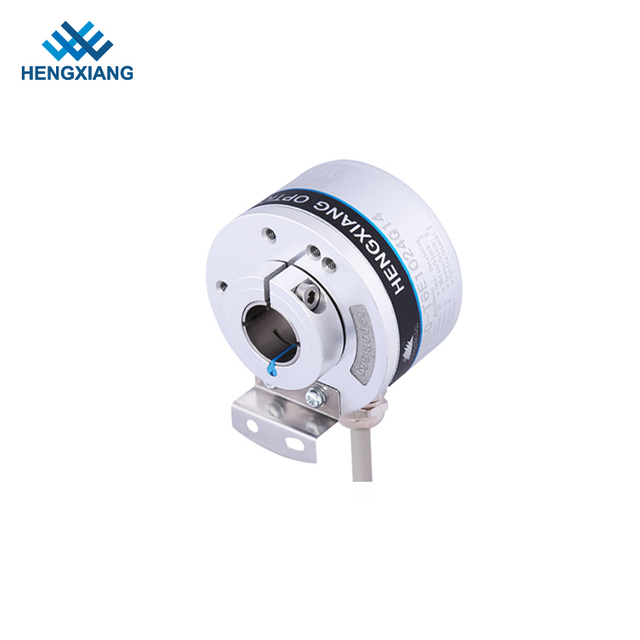
This is where rotary encoders come into play. This fingernail-sized precision component acts as the "precision sensory system" in autonomous driving, with its technical parameters defining the boundaries of a vehicle's perception capabilities.
First, it is the core of the vehicle's "proprioception." Take our company's high-precision optical encoder as an example: it achieves a resolution of up to 17 bits (131,072 lines per revolution). This means it can detect angular changes as small as 0.0027 degrees — equivalent to capturing a displacement thousands of times thinner than a strand of hair during a single wheel rotation. It is this extreme precision that enables the vehicle control system to know in real time: how many degrees has the wheel turned? What is the speed? Is the direction forward or reverse? This data forms the foundational information for functions like precise steering, stable driving, and automatic parking. Without such precise "self-awareness," even the smartest "brain" of the vehicle cannot effectively command its "limbs."
Second, it serves as an irreplaceable link in the safety redundancy system. In complex driving environments, the system requires multi-source information for cross-validation. Cameras can be blinded by strong light, radar can be attenuated by heavy rain, and LiDAR can be misled by heavy snow. Rotary encoders, however, directly measure mechanical motion, unaffected by weather or lighting. With response frequencies up to 1 MHz, they deliver direct, reliable data about the vehicle's own motion at the microsecond level. This data, when fused and cross-checked with inputs from other sensors, ensures the system can accurately assess the vehicle's status even in adverse conditions. When visual sensors fail due to dense fog, it's the encoder that quietly tells the vehicle: you're still on the right track.
Finally, it safeguards the safety baseline of every tiny movement. Whether it's a smooth lane change on the highway or a tight park with only five centimeters of clearance front and back, every micro-command from the steering wheel ultimately needs to be translated into precise wheel rotation. Our absolute encoders, even after power loss, retain the absolute position of the shaft, ensuring the vehicle knows the steering wheel angle the moment it starts up — no recalibration needed. This level of control accuracy, measured in milliradians, ensures that every decision made by the autonomous driving system is faithfully executed, adding a layer of safety that originates from the very foundation.
These precision "sensory components" act as the neural endings through which the autonomous driving system "perceives itself." They are among the foundational building blocks that ensure a vehicle operates safely, stably, and controllably in a complex world. With their sub-micron-level sensing capabilities, they transform every physical rotation into precise digital signals, allowing the algorithm to "see" and "control" the vehicle's every move.
Conclusion: Embrace the Future, But Never Stop Thinking
There is no doubt that autonomous driving will profoundly change the way we live, bringing enormous convenience and social benefits. But this "liberation" does not come without cost; it is accompanied by profound new questions about trust, ethics, safety, and social structures.
We embrace the possibilities brought by the "disappearing" steering wheel, but we must not overlook the deep challenges it presents. Technology evolves at a breakneck pace, but the thinking about responsibility, ethics, and the human-machine relationship requires broader and deeper discussion and consensus across society.
The roads of the future are paved not only with asphalt but also with human wisdom and responsibility. As we envision the convenience of hands-free travel, let us also remember those precision "senses" that silently safeguard every tiny movement — the rotary encoders that resolve every rotation with 17-bit precision and guard every decision with microsecond-level response. They remind us that safety begins with the most fundamental and reliable perception and control. Perhaps that is the most solid foundation on the path to true "liberation."