Views: 51223 Author: Site Editor Publish Time: 2026-04-30 Origin: Site


In precision motion control, there is one fundamental question every machine must answer: "Where am I right now?" An absolute encoder answers this question instantly, uniquely, and permanently — even after a power loss.
Unlike an incremental encoder, which only reports changes in position and requires a homing sequence to find zero after each restart, an absolute encoder assigns a unique digital code to every single shaft position. This means the exact angular or linear position is available immediately at power-on, no reference movement needed.
How it works
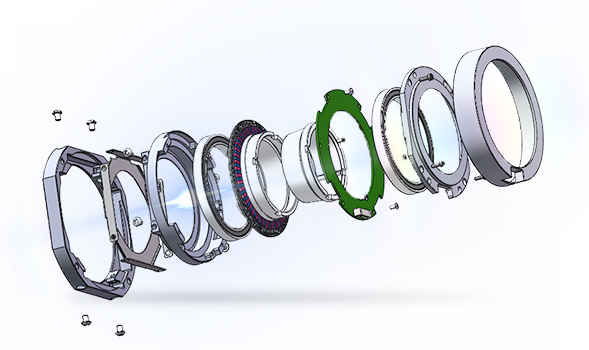
An absolute rotary encoder uses a disc with multiple concentric tracks of opaque and transparent segments. A light source shines through the disc onto a photodetector array, which reads the unique binary pattern corresponding to that exact angle. In magnetic absolute encoders, rotating magnets interact with custom Hall-effect or magnetoresistive sensor arrays to generate the unique code. The total number of unique positions per revolution determines the resolution — typically ranging from 10 bits (1,024 positions) to 17 bits (131,072 positions) or higher.
Key Advantages
The single biggest advantage of absolute encoders is their memoryless operation. Factory robots, medical scanners, radar pedestals, and satellite tracking systems all depend on knowing exactly where they are the moment power is applied. A homing crash — common in systems that lose reference during power failure — is simply eliminated.
Absolute encoders also excel in safety-critical applications. In elevator traction machines, wind turbine pitch control, and surgical robots, any position ambiguity after a power interruption can be catastrophic. The encoder's unique code output is verifiable and inherently redundant in many designs.
Single-turn vs. Multi-turn
Single-turn absolute encoders track position within one full revolution. When the application requires tracking over multiple turns — such as a ball screw that rotates dozens of times — multi-turn absolute encoders are used. They add a gear-driven stage or an energy-autonomous magnetic counter that records the number of full rotations even when system power is completely off. This makes them ideal for crane hoists, telescope positioning, and linear actuator feedback.
Output Interfaces
Modern absolute encoders communicate through a variety of industrial interfaces. SSI (Synchronous Serial Interface) remains a robust standard, while BiSS and EnDat offer higher speed and bidirectional capability for advanced servo drives. For multi-axis systems, CANopen, EtherCAT, and PROFINET allow absolute encoders to integrate seamlessly into real-time fieldbus networks.
Applications Across Industries
Absolute encoders are everywhere in modern automation: from the swiveling mast of a forklift to the robotic welding arm in an automotive line; from the solar panel heliostat in a concentrated solar plant to the fin actuator of a guided munition. In each case, losing position is not an option.
Made by Shanghai Hengxiang
Shanghai Hengxiang Optical Electronics Co., Ltd. has been manufacturing precision absolute encoders since 2001. Our product line includes both optical and magnetic absolute rotary encoders with resolutions up to 17 bits, available in solid shaft and hollow shaft designs. We offer multiple output options including SSI, BiSS, and CANopen. With in-house R&D and full production capability, we deliver encoders rated to IP67, operating reliably from -40°C to 105°C, with strong resistance to electromagnetic interference. Customization is available for volume orders.
The Bottom Line
Absolute encoders eliminate the risk, time, and complexity of homing routines. They are the choice when position integrity is non-negotiable. For factory automation, medical technology, renewable energy, or defense systems — when failure is not an option, the answer is absolute.